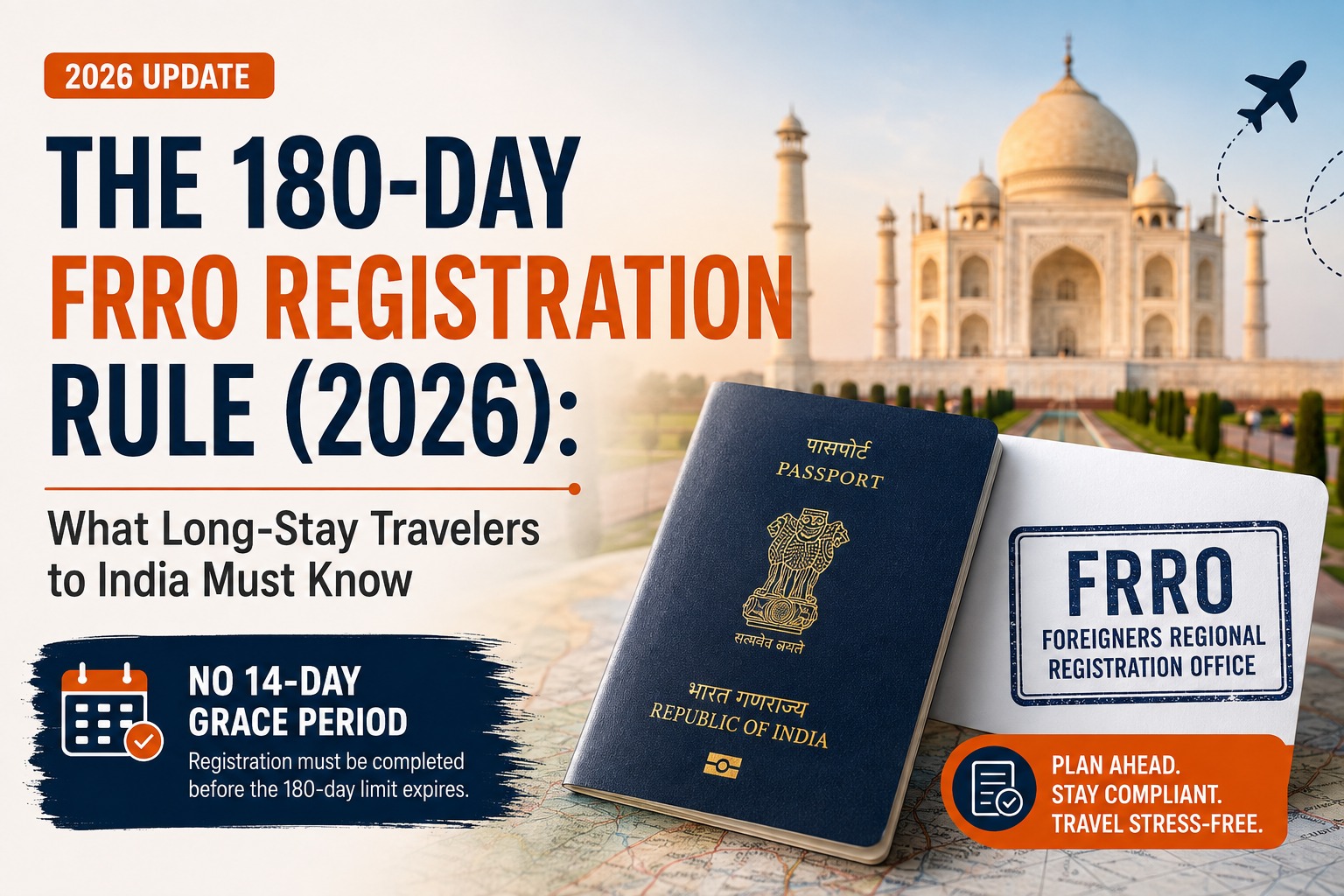
India's 180-Day FRRO Rule 2026: What US Business Travelers and OCI Holders Should Know
If you're a US citizen on an extended work assignment in India, or an Indian-origin American with OCI status planning a longer stay, there's a mid-2026 rule change worth understanding before you travel — not after you're already deep into your trip.
What Changed
Previously, foreign nationals who entered India on a visa capped at 180 days per visit had a 14-day grace period after hitting that limit to complete FRRO (Foreigners Regional Registration Office) registration if they needed more time. That buffer no longer exists. Under the revised rule, registration must now be completed before the 180-day limit expires — not within 14 days after. If you wait until you've already crossed the threshold, you're already out of compliance. Who This Affects Among US Travelers This rule is specifically relevant to categories with a per-visit 180-day cap, most notably the Business Visa — a common choice for Americans on extended assignments, consulting engagements, or multimonth project work in India. It's a different situation from most Tourist Visas, which are typically capped by total days per calendar year rather than a single continuous stay. Most American tourists won't trigger this rule unless their circumstances change mid-trip.
A Note for OCI Holders
If you hold an OCI card, your day-to-day entry and stay rights in India work differently from a standard e-Visa, and OCI holders are generally not subject to the same visa-duration caps as e-Visa travelers. That said, immigration frameworks around registration and long-stay compliance have been under broader review alongside these 2026 changes, and requirements can be updated with limited notice. If you're an OCI holder planning an extended stay in India — well beyond a normal visit — it's worth directly confirming current registration expectations rather than assuming older rules of thumb still apply.
Separately, OCI holders should also keep track of a related but distinct requirement: any new US passport must be logged in the OCI system within 90 days of renewal, with a penalty attached to missing that window. It isn't the same rule as FRRO registration, but it's part of the same broader shift toward stricter, deadline-driven compliance for Indian-origin travelers.
Why the Change Matters
Two things make this more consequential than it might first appear:
1. Registration is now proactive, not reactive. There's no room for "I'll handle it once I hit the limit." You need to track your own timeline and act before the deadline.
2. Extended-stay permissions are now framed around emergent circumstances, signaling a generally stricter review posture for long stays overall — not just a shifted deadline.
This sits alongside a broader tightening of India's immigration enforcement in 2025–2026, including expanded biometric data collection at arrival and steeper penalties for overstays. For an American on a long-term work assignment, that combination is worth taking seriously.
What Happens If You Miss the Deadline
Falling out of compliance under India's current framework can mean:
• Financial penalties
• Complications with future Indian visa or OCI applications
• In more serious cases, restrictions on future entry These aren't automatic for every case, but the direction of the framework is toward stricter enforcement, which is exactly why proactive planning is worth the effort.
A Practical Timeline for US Business Travelers
1. Note your exact arrival date and calculate your 180-day mark immediately — don't estimate it later from memory. 2. Reassess your plans well before that date, not at day 150 or 160. Build in real decision-making time.
3. If you need more time, start FRRO registration before the 180- day limit, not after. Portal delays and document issues eat into your buffer.
4. Keep your visa approval, entry stamp, and any employer or project documentation organized — registration reviewers expect a clean, consistent paper trail.
5. If your situation genuinely qualifies as emergent, have that documentation ready, since extensions are now explicitly tied to this standard.
Common Mistakes US Travelers Make
• Assuming the old 14-day grace period still applies — it doesn't
• Waiting until close to day 180 to start thinking about registration at all
• Confusing a Business Visa's continuous 180-day cap with a Tourist Visa's calendar-year cap
• Treating OCI status as a blanket exemption from all registration or compliance questions, without confirming current requirements for genuinely extended stays
Final Thoughts
For American business travelers, the practical takeaway is simple: know your 180-day date from the moment you land, and start any registration conversation well before you approach it. For OCI holders planning an unusually long stay, the takeaway is similar — don't rely on how things worked on your last trip; confirm current expectations directly.
If you're planning an extended Business Visa trip to India, or you're unsure how these rules apply to your specific OCI or visa situation, our team can help you map out your timeline and documentation well ahead of any deadline.
This article is for general informational purposes. India Travel is a private assistance service and not a government website. Immigration rules can change; always confirm current requirements with the official FRRO portal or a licensed immigration professional before making long-stay travel decisions.


